
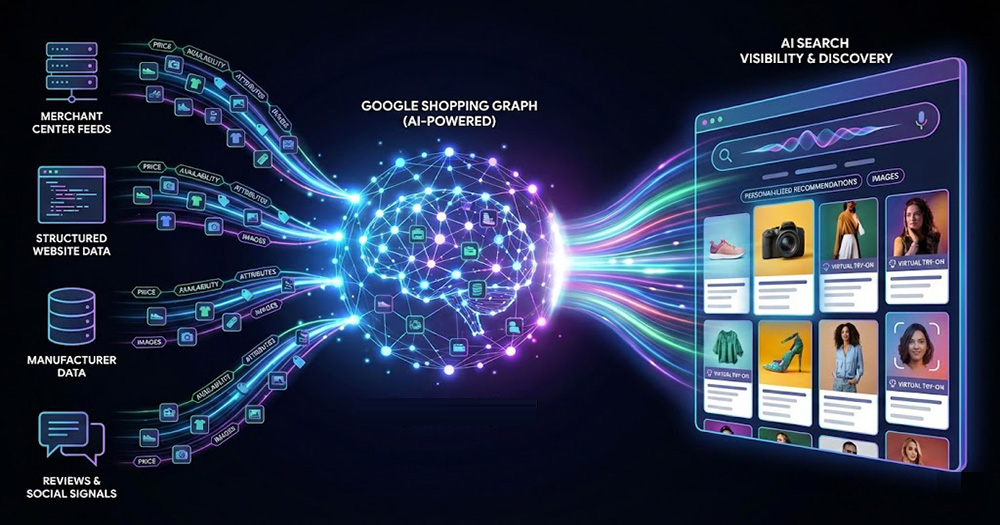
In the next generation of ecommerce, the journey from “intent” to “purchase” is no longer a path through a list of links. Instead, it is a conversation. As search engines morph into intelligent shopping assistants, the focus for Shopify merchants has shifted toward the Google Shopping Graph, a massive, real-time “brain” containing over 50 billion product listings.
To be visible in this new era, your data must be active, structured, and authoritative. Here is how to position your store at the centre of the AI-driven discovery ecosystem.
1. Feed the Machine: High-Fidelity Data Streams
AI models like Gemini and Perplexity don’t “browse” your store like a human; they ingest your data through the Shopping Graph. If your data is incomplete, your products are essentially invisible to the AI’s reasoning engine.
- GTINs are Non-Negotiable: Unique Product Identifiers (Global Trade Item Numbers) are the DNA of the Shopping Graph. They allow the AI to instantly connect your product to expert reviews, price history, and YouTube demonstrations across the entire web.
- The Power of Attributes: AI search thrives on “Query Fan-out”—the ability to break a prompt like “breathable running shoes for wide feet under £100” into specific filters. You must provide rich attributes—
material,fit,pattern,size_system, and evenintended_usewithin your Shopify admin or Merchant Center feed. - Real-Time Syncing: With the Shopping Graph refreshing billions of times per hour, price or stock “drift” erodes AI trust. Use the Content API rather than manual file uploads to ensure your store’s reality matches the AI’s knowledge.
2. Conversational Mapping: Writing for “AI Mode”
The way people discover products has shifted from short keywords to complex, natural-language prompts. Your product pages (PDPs) need to reflect this conversational shift.
- The “40-Word Narrative”: AI systems often synthesise a “Key Takeaway” for a product. Ensure your product descriptions lead with a concise, factual 40-50 word summary that answers: What is it, who is it for, and what primary problem does it solve?
- Semantic Variety: Don’t just repeat a single keyword. Use a “semantic cloud” of related terms. If you sell “linen shirts,” include terms like “moisture-wicking,” “natural fibres,” and “summer essentials.” This helps the AI’s Large Language Model (LLM) understand the context of your offering.
- Visual Intelligence: In a world of visual search, your images are data points. Upload high-resolution, multi-angle shots and use descriptive Alt Text. The AI uses these to power features like “Virtual Try-On” and “Shop the Look.”
3. Trust as a Data Point: E-A-T and Sentiment
AI search is designed to be helpful, which means it will avoid recommending products with “messy” or untrustworthy data. Trust is now a technical requirement.
- Structured Sentiment: AI Overviews don’t just see a 5-star rating; they read the content of reviews to summarize pros and cons. Use a Shopify review app that exports Review Schema (JSON-LD), allowing the AI to “read” that customers love the durability but find the sizing runs small.
- Commercial Transparency: Shipping speeds, return policies, and warranty details should be formatted in clear, machine-readable tables or FAQ sections. This allows you to feed these specific brand “facts” directly into the AI’s response bank.
- Manufacturer Authority: If you create your own products, claim your brand in Google Manufacturer Center. This grants you “Authoritative” status over the product data, ensuring the AI uses your specs and brand story rather than a third-party’s.
The New Bottom Line: From Search to Synthesis
In 2026, the goal is no longer to “rank.” The goal is to be the most trusted and accessible answer to a shopper’s question. By optimising for the Google Shopping Graph, you move your Shopify store from a static page to a dynamic entity that AI agents can confidently recommend, compare, and eventually, purchase on behalf of the user.